
When I developed the Portfolio Waterfall strategy back in late 2014, the objective was straightforward: create a retirement-income strategy that could generate consistent cash flow with the durability to endure a range of market environments. But income was never the only thing I was solving for. I was also screening for something I believe matters just as much, and I still consider it the most important question to ask of any strategy: will this help the client stay invested? Performance, cost, risk metrics, manager pedigree, those things matter, but only if the client is still in their seat when it counts.
That question came from watching the same pattern play out again and again. A well-built plan would meet a rough stretch of market, and the client, not the strategy, would break first. They would see the headlines, feel the fear, and move to cash at exactly the wrong moment. Over time I became convinced that how a strategy is built, and how it behaves when a client is under stress, matters every bit as much as how it looks on paper.
For a long time, this was a conviction drawn from my experience. Next month, it gets something more. The American College of Financial Services is publishing a working paper by Dr. Chet R. Bennetts. This new research directly examines the Portfolio Waterfall. The paper’s central finding is the very thing I designed the strategy around: the structure of the Portfolio Waterfall helps clients stay invested and reinforces healthy financial behavior.
What struck me most is how the research explains why. Dr. Bennetts draws on neuroscience to make a point that matches what I have seen across the desk for years. The brain does not make financial decisions with one steady system. The analytical part we rely on to build and follow a plan tends to go quiet under stress, while the emotional, story-telling part takes over. Right when a clear head matters most, it becomes hardest to keep one. In stressful moments, “this time is different” starts to feel true.
The implication is simple but important. A plan that asks the client to make a hard, analytical decision in the middle of a market panic is fighting the brain at its weakest moment. A plan that already has the response built into its structure is not asking the client to stay calm. It is making calm the default.
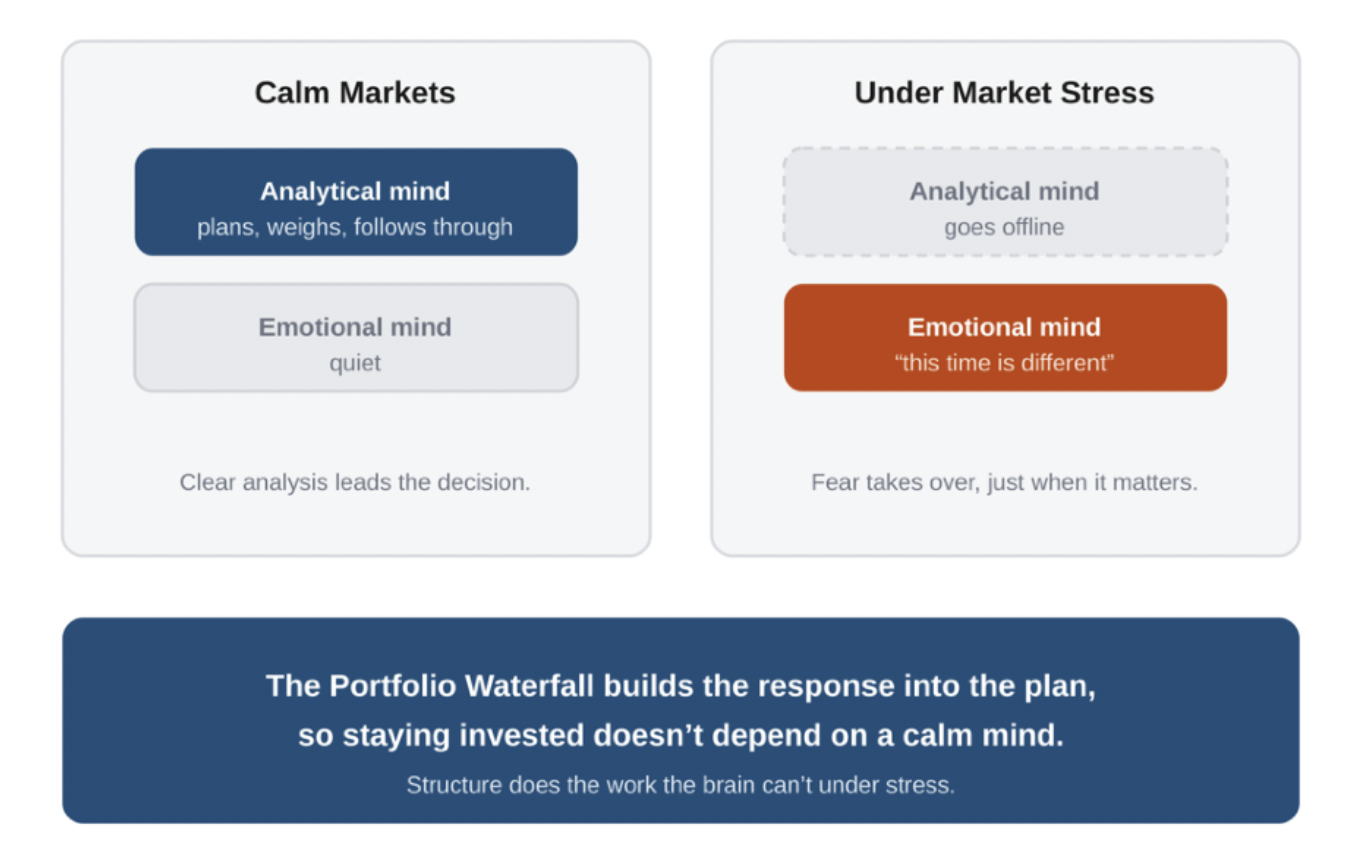
This is exactly what the Portfolio Waterfall is designed to do. Withdrawals are funded first from the cash flow the portfolio already produces — through dividends, interest, and other nondestructive sources — before any shares are sold. The client’s income does not depend on selling into a falling market. When the headlines turn ugly, there is a visible pool of cash covering the bills, and the growth holdings are left alone to do what they are there to do.
Dr. Bennetts’ research on the Portfolio Waterfall suggests the answer to this question is yes, and the research explains the mechanism. When a client does not have to choose between funding their life and selling into a falling market, the fear that drives bad decisions loses its trigger. Some clients go a step further and treat a downturn as a chance to add to their holdings, the very opposite of the panic-selling that erodes so many retirement plans. Staying invested stops being a test of willpower and becomes the natural result of how the plan is built.
The paper also confirms something I have long believed about how we present this work. When clients help build their plan, and understand what they own and why, it stops being “what my advisor told me to do” and becomes “what I built for my family.” That sense of ownership is what holds when markets turn. This is the same reason I show clients how a mutual fund is constructed before I ever talk about the broader strategy. Understanding comes first, because understanding is what people hold onto under pressure.
I have always believed the right strategy is not the one that looks best on a screen. It is the one the client can understand, trust, and stay committed to when it matters most. It is encouraging to see rigorous academic work arrive at the same conclusion. When Bennetts’ paper is released next month, I would encourage every advisor to read it, not because it introduces a new idea, but because it puts serious research behind one of the oldest truths in our business: the best plan is the one your client will actually keep.
